

Looking for powerful dedicated server hosting without breaking the bank? Today's enterprise-grade dedicated server hosting costs significantly less than it did just a few years ago. While many technology services continue to increase in price, we've observed a remarkable 60% reduction in dedicated hosting services costs in 2024.
This dramatic price drop isn't happening by chance. Many dedicated server hosting companies now offer unlimited bandwidth as a standard feature, alongside exceptional reliability with 99.99% uptime guarantees. Furthermore, the industry has evolved to provide top-tier performance at surprisingly affordable prices. In fact, customers rate these improved services at 4.7 out of 5 stars, demonstrating that lower prices haven't compromised quality.
Throughout this article, we'll explore why dedicated server hosting prices have fallen so dramatically, what makes a server truly "enterprise-grade," and how to select the best dedicated server host for your specific needs. Whether you're considering managed dedicated server hosting or evaluating bare-metal options, you'll discover how to maximize value without sacrificing performance.
What Makes a Server 'Enterprise-Grade' in 2024

Image Source: We Buy Used IT Equipment
Enterprise-grade servers represent the backbone of modern business infrastructure, offering exceptional reliability and performance for mission-critical applications. Unlike consumer-grade alternatives, these powerful systems are built to operate continuously in demanding environments.
Dedicated server vs managed dedicated server hosting
When exploring dedicated server hosting options, you'll encounter two primary models. With standard dedicated servers, you receive exclusive access to all hardware resources but handle your own administration. This approach works well when your company has experienced IT staff who can manage server configurations and maintenance.
However, managed dedicated server hosting provides a compelling alternative for businesses that prefer to focus on core activities rather than server administration. With managed hosting, the provider handles tasks like updates, security patches, monitoring, and troubleshooting while you maintain control over your applications. This arrangement proves especially beneficial for companies with limited IT teams or those seeking to minimize downtime, as most managed services include disaster recovery options.
Hardware specs: Dual CPUs, ECC RAM, NVMe storage
Modern enterprise-grade servers feature several distinctive hardware elements that separate them from standard offerings:
Dual processors enhance multitasking capabilities and processing power, making them ideal for compute-intensive workloads. Systems featuring Intel Xeon or AMD EPYC processors can handle massive parallel processing tasks.
ECC RAM (Error-Correcting Code memory) automatically detects and fixes memory errors before they cause data corruption or system crashes. This capability is essential for mission-critical applications where even minor errors could lead to significant consequences.
NVMe storage provides revolutionary data access speeds compared to traditional SATA drives. This technology takes a parallel approach to data storage, functioning like a multi-lane superhighway rather than a single-lane road.
Use cases: SaaS, ML, e-commerce, and game servers
Enterprise-grade servers excel in environments demanding uncompromising reliability and performance. They power high-traffic e-commerce platforms where even a 1-second delay can reduce conversions by 7%. Additionally, they support data-intensive applications like machine learning, SaaS delivery, and online gaming where rapid data access and processing are paramount.
Traditional Cost Structure of Dedicated Hosting Services
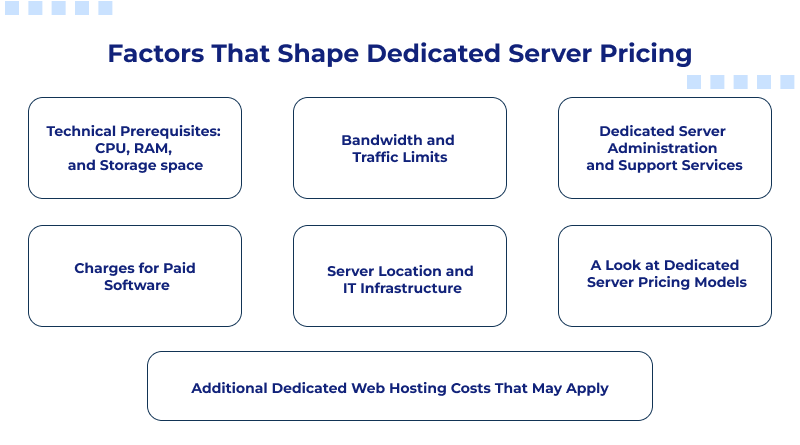
Image Source: Web Hosting | MilesWeb
The financial investment in dedicated server hosting varies considerably, typically ranging from $50 to over $1000 per month depending on several key factors. Understanding this traditional cost structure helps explain why the recent 60% price reduction represents such a dramatic shift in the industry.
Breakdown of dedicated server hosting price components
The hardware configuration primarily drives dedicated server pricing. When examining traditional pricing models, we notice distinct tiers:
- Entry-Level Servers: $40-$100 monthly with basic processors and limited RAM
- Professional Servers: $100-$250 monthly with mid-range components
- Enterprise Servers: Exceeding $500 monthly with premium specifications
CPU selection constitutes the largest price factor, with each tier upgrade potentially adding $50-$300 monthly to your costs. Memory upgrades typically increase expenses by $30-$100 monthly per tier, while storage enhancements can add $40-$150 monthly depending on technology.
Licensing and control panel costs (cPanel, Webuzo)
Operating system selection substantially impacts your overall dedicated server expenses. Linux distributions generally come at no additional cost, whereas Windows Server licenses add approximately $20-$125 monthly depending on the edition.
Control panel licensing represents another significant expense. Traditional control panel options include:
- cPanel Solo: $19.88 monthly
- Webuzo Personal: $5.88 monthly
Additionally, database software and optional security tools may add $15-$60 monthly to your hosting budget.
Bandwidth and data center location impact on pricing
Data center location fundamentally shapes dedicated server pricing through multiple channels. Facilities situated directly on the internet backbone benefit from peering relationships that substantially reduce transit costs. This strategic positioning enables significantly lower data transfer rates compared to facilities in less connected locations.
Power costs vary dramatically between regions, directly affecting server pricing. Facilities near abundant power sources (like hydroelectric dams) operate more economically than those in power-constrained urban areas. Consequently, the same server cabinet that costs $2000 monthly in Manhattan might cost just $400 in Phoenix.
Labor costs, real estate expenses, and cooling requirements further contribute to regional pricing variations that ultimately pass through to customers.
8 Reasons Why Enterprise-Grade Dedicated Hosting Costs 60% Less in 2024
The dedicated server hosting landscape has experienced a profound transformation. Currently, the market stands at USD 20.13 Billion and is projected to expand at a 19.1% CAGR through 2032. Here's why enterprise-grade dedicated hosting has become markedly more affordable:
1. Hardware cost reduction due to AMD/Intel competition
Intel's once-unassailable dominance has declined from nearly 100% to roughly 63% of server CPU market share. Meanwhile, AMD's EPYC processors have captured about one-third of every dollar spent on server CPUs. This rivalry has driven prices down as AMD's multi-core performance advantage offers better value for virtualization and cloud workloads.
2. Cheaper NVMe and SSD storage availability
Modern SSDs perform up to 35 times faster than older HDDs while drawing significantly less power. PCIe 4.0 NVMe drives achieve random read speeds up to 1,100,000 IOPS. Additionally, V-NAND density has increased from 32 to 176 layers, providing 5.5 times more storage in the same physical space.
3. Open-source control panels replacing paid ones
Traditional control panels like cPanel Solo ($19.88 monthly) and Webuzo Personal ($5.88 monthly) have given way to free alternatives. These open-source options provide interactive management for webmasters without technical expertise.
4. Global data center expansion reducing latency costs
Strategic facility placement near internet backbones has substantially reduced transit costs. Power expenditures vary dramatically between regions—the same server cabinet costing $2000 monthly in Manhattan might cost just $400 in Phoenix.
5. Automation in server provisioning and monitoring
Streamlined deployment processes and automated monitoring systems have eliminated numerous manual operations, decreasing labor costs and ultimately reducing customer prices.
6. Increased competition among dedicated server hosting companies
As providers shift toward integrated solutions that accommodate hybrid and multi-cloud models, they're competing more aggressively on price and features to capture market share.
7. Bundled services like free migration and backups
Hosting companies now frequently include previously premium features as standard offerings—expert migration services handle entire transfers, along with up to 30 daily offsite backups, free SSL certificates, and CDN integration.
8. Dedicated server hosting with unlimited bandwidth becoming standard
Unmetered dedicated servers with no bandwidth limitations have become commonplace. These solutions particularly benefit streaming or download-heavy applications, with some providers offering 10Gbps unmetered connections as standard features.
How to Choose a Cost-Effective Dedicated Server Host
Selecting the right dedicated server host requires careful evaluation of multiple factors beyond just price. Let me guide you through the decision process.
Evaluating managed dedicated server hosting plans
Managed dedicated server hosting provides substantial value through time savings and expert assistance. Basic managed servers typically cost between $150-500 monthly, while enterprise-level solutions may range from $1000-5000+ monthly. Essentially, you're paying for the provider to handle routine maintenance, security patches, and system monitoring so your team can focus on core business functions. Unmanaged options start at just $50-100 monthly, making them suitable for organizations with technical expertise. Consider whether your operation needs 24/7 technical assistance or if you have the internal resources to manage server administration independently.
Comparing server tiers: Entry vs Medium vs Advanced
Server tiers differ primarily in hardware specifications and performance capabilities:
- Entry-level: 4-8 cores, 16-32GB RAM, 1TB storage (starting at $50 monthly)
- Mid-tier: 12-16 cores, 64-128GB RAM, 2TB SSD (approximately $200-400 monthly)
- Advanced: 24-64 cores, 256-512GB RAM, 4TB+ NVMe (exceeding $500 monthly)
Fixed pricing works best for consistent workloads, whereas tiered pricing clearly outlines what you receive at each level. For seasonal traffic fluctuations, consider usage-based pricing models that prevent paying for idle resources during quiet periods.
Assessing support, uptime, and SLAs
A host's uptime guarantee reflects their confidence in their infrastructure. Industry standards range from 99.9% (allowing nearly 9 hours downtime yearly) to 99.99% (roughly 52 minutes yearly). Above all, examine the SLA's details, including what counts as downtime and compensation methods. Hardware replacement time is equally crucial – look for providers guaranteeing replacement in hours rather than days, ideally under 2 hours. Firstly, evaluate whether they monitor CPU, RAM, disk I/O, network, services, SSL certificates, and processes. Secondly, confirm their security protocols include hardening, patch schedules, and intrusion detection.
Conclusion
The dedicated server hosting market has undergone remarkable transformation, resulting in enterprise-grade solutions becoming significantly more affordable. Through fierce competition between AMD and Intel, advancements in storage technology, and the proliferation of open-source alternatives, businesses can now access high-performance dedicated hosting at a fraction of previous costs.
Undoubtedly, this 60% reduction represents excellent news for organizations seeking reliable infrastructure without excessive expenditure. Companies now receive better specifications – dual processors, ECC RAM, NVMe storage – while paying substantially less than just a few years ago. Additionally, many providers include previously premium features as standard offerings, from unlimited bandwidth to comprehensive backup solutions.
When selecting your dedicated server host, therefore, focus beyond price alone. Consider whether managed or unmanaged hosting aligns with your technical capabilities, evaluate hardware specifications against your workload requirements, and thoroughly examine support responsiveness and SLA guarantees.
The democratization of enterprise-grade dedicated hosting means businesses of all sizes can now access infrastructure previously reserved for large corporations with substantial IT budgets. This trend appears likely to continue as competition intensifies, benefiting customers with ever-improving value propositions. Whether you run SaaS applications, e-commerce platforms, or resource-intensive gaming servers, dedicated hosting has never offered better performance-to-price ratios than it does today.